




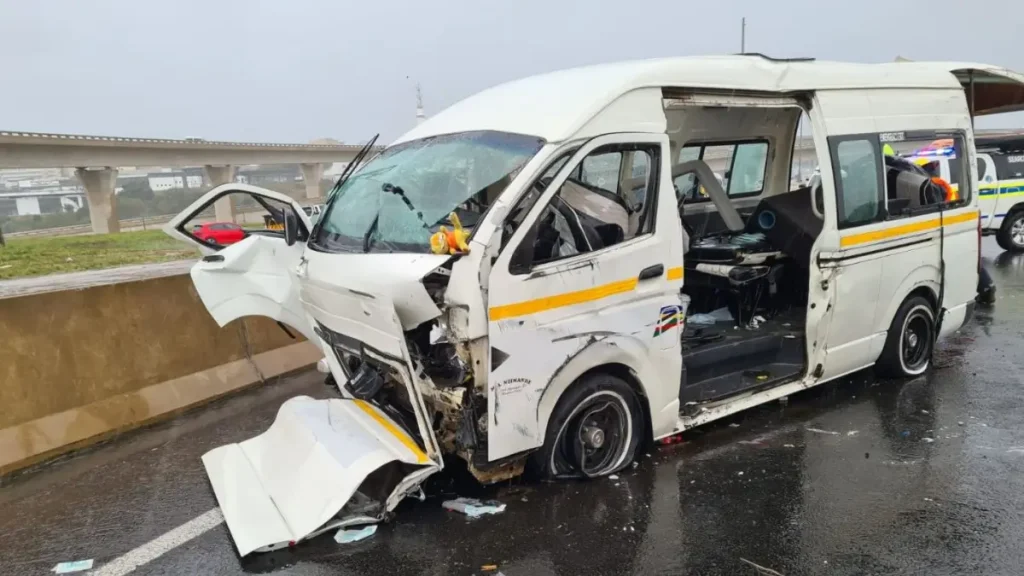
Road accidents involving minibus taxis remain a regular occurrence on South Africa’s roads, particularly in high-traffic provinces such as Gauteng. With taxis serving as a primary mode of transport for millions of commuters each day, collisions often leave passengers injured and uncertain about their legal and financial position.
South African law allows taxi passengers injured in road accidents to claim compensation through the Road Accident Fund (RAF). The scheme applies regardless of who caused the crash, provided the accident involved negligent driving and occurred on a public road.
ALSO READ: How to Fill in Road Accident Fund (RAF) Claims Forms: A Step-by-Step Guide
What is the Road Accident Fund?
The Road Accident Fund is a state-mandated compensation scheme established to provide financial relief to people injured in road accidents, as well as dependents of those who are killed. It covers accidents involving motor vehicles on public roads and applies to drivers, passengers, and pedestrians.
In the case of taxi accidents, passengers are treated differently from drivers. While drivers may face reduced compensation if they are found partly responsible, passengers are generally entitled to claim compensation even when the taxi driver was negligent.
Can taxi passengers claim from the RAF?
Yes. Passengers injured in taxi accidents are legally entitled to submit claims to the RAF. This applies in situations where:
• The taxi driver caused the accident
• Another vehicle caused the accident
• Multiple drivers were involved
• The responsible vehicle cannot be identified
Passengers are not required to prove that they were free from fault. Claims focus on whether negligent driving caused the accident and whether the injuries are linked to the collision.
Types of compensation available to taxi passengers
The RAF provides compensation based on the nature and severity of injuries, as well as the financial impact on the claimant.
Taxi passengers may claim for:
Medical expenses
This includes hospital treatment, surgery, medication, rehabilitation, and related healthcare costs arising from the accident.
Loss of income or earning capacity
Passengers who are unable to work temporarily or permanently due to their injuries may claim for income lost as a result of the accident.
General damages
Compensation for pain, suffering, emotional trauma, and loss of quality of life may be awarded in cases involving serious injuries, subject to medical assessment.
Funeral and loss of support claims
Where a passenger dies as a result of a taxi accident, dependants may claim funeral expenses and loss of financial support.
Time limits for taxi passenger claims
RAF claims are subject to strict legal deadlines.
• Claims where the responsible driver or vehicle is known must be lodged within three years of the accident
• Hit-and-run claims must be lodged within two years
• Claims must generally be finalised within five years
Failure to submit claims within these periods can result in forfeiture of compensation.
What documentation is required?
Submitting a RAF claim requires detailed and accurate documentation. Commonly required documents include:
• A police accident report or case number
• Medical records and hospital reports
• A completed RAF claim form
• A serious injury assessment report, where applicable
• Proof of income or financial loss
• Details of the taxi and driver, if available
Incomplete or missing documentation is one of the most frequent causes of delays.
Medical assessments and serious injury requirements
General damages are only awarded for injuries classified as serious under the RAF framework. Claimants must undergo a medical assessment to determine whether injuries meet this threshold.
Not all injuries qualify. Minor injuries may be compensated for medical costs and income loss but may not meet the criteria for general damages.
Challenges faced by taxi passengers when claiming
Although the RAF provides an important safety net, claimants often encounter difficulties during the process.
Common challenges include:
• Long processing times
• Requests for additional documentation
• Disputes over the seriousness of injuries
• Reduced payouts due to shared negligence findings
These factors can delay final settlement, particularly in complex or high-value claims.
What This Means for Gauteng Residents
In Gauteng, where taxis form the backbone of daily transport, RAF passenger claims affect a significant portion of the population. Injuries sustained during routine commuting can disrupt employment, education, and household income.
Understanding passenger rights under the RAF framework is essential, as access to compensation depends on timely reporting, accurate documentation, and compliance with legal requirements.
Frequently Asked Questions
Can passengers claim even if the taxi driver caused the accident?
Yes. Passengers may claim regardless of who was at fault.
Can passengers claim in hit-and-run cases?
Yes, provided the claim is lodged within two years of the accident.
Are medical expenses always covered?
Medical costs linked to accident injuries are generally covered, subject to verification.
Do all injuries qualify for general damages?
No. Only injuries classified as serious after medical assessment qualify.
How long does it take for claims to be paid?
Processing times vary and can take months or longer, depending on the complexity of the claim.
What Happens Next
Taxi passenger claims continue to form a substantial part of the RAF’s workload nationwide. While the legal framework protects injured passengers, access to compensation depends on adherence to reporting deadlines and documentation requirements.
As road safety concerns persist, the RAF remains a central mechanism for addressing the financial consequences of taxi-related injuries across South Africa.