


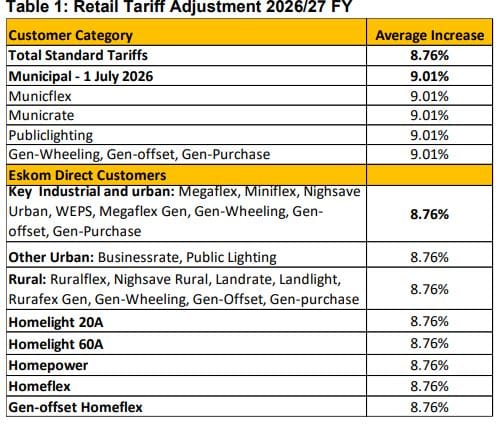
The Eskom tariff increase for 2026 is now official, and it will affect both households and businesses across South Africa. NERSA approved an average tariff increase of 8.76% for Eskom direct customers and 9.01% for municipal customers for the 2026/27 financial year. The new Eskom direct tariffs apply from 1 April 2026, while municipal increases usually start from 1 July 2026.
For many South Africans, this is not just another policy change. It means tighter monthly budgets, higher operating costs, and more pressure on already stretched households. However, understanding what changed, when it starts, and how it affects your bill can help you plan better. Here is a simple breakdown of the latest Eskom tariff increase 2026, why prices are rising, and how to reduce the pressure on your electricity budget.
How Much is the Eskom Tariff Increase in 2026?
NERSA approved the latest NERSA tariff increase on 5 March 2026. The regulator said Eskom direct customers will face an average increase of 8.76%, while municipalities buying electricity in bulk from Eskom will face an average increase of 9.01%.
ALSO READ: Gauteng Social Housing Programme
These increases apply on different dates:
Eskom direct customers
If you buy electricity directly from Eskom, the new tariffs apply from 1 April 2026 to 31 March 2027.
Municipal customers
If your electricity account comes from your municipality, the increase is expected from 1 July 2026 to 30 June 2027, in line with the Municipal Finance Management Act.
That timing difference explains why the municipal increase is slightly higher on paper. NERSA says Eskom must recover its approved revenue within its own April-to-March financial year, while municipalities work on a July-to-June financial year.
What Changed in the 2026 Eskom Tariff Increase?
One important point is that the 2026 increase is higher than what had previously been expected. In January 2025, NERSA had originally approved a 5.36% increase for 2026/27 and 6.19% for 2027/28.
That changed after a redetermination process. Reuters reported in February 2026 that NERSA revised the numbers after admitting calculation errors and reconsidering the tariff path. As a result, the 2026/27 increase moved up from 5.36% to 8.76%.
In short, the latest electricity price increase in South Africa is not only another annual increase. It is also a bigger rise than many consumers expected based on the earlier decision.
Why Are Electricity Prices Rising?
NERSA determines Eskom’s allowed revenue through the Multi-Year Price Determination framework. Eskom then submits a retail tariff application to show how the approved revenue will be recovered across customer categories.
In practical terms, electricity tariffs are rising because Eskom still needs revenue for:
Cost recovery
The utility needs to recover the cost of generating, transmitting, and distributing electricity.
Infrastructure and system maintenance
South Africa’s electricity network requires ongoing maintenance and investment. Eskom’s tariff documents also show structural changes designed to recover more fixed costs through specific charges, rather than only through energy consumed.
Debt and financial sustainability
Reuters reported that Eskom has argued it needs tariff support to deal with issues such as rising debt, coal contract costs, and broader financial sustainability pressures.
What Does The Eskom Price Hike Impact Look Like on Real Bills?
The exact Eskom price hike impact will depend on your tariff type, how much electricity you use, and whether you buy directly from Eskom or from a municipality. Eskom’s tariff material shows that residential users are not all on one simple rate. Residential tariffs include options like Homelight, Homepower and Homeflex, and some of these now include stronger fixed-charge components.
That means your bill may rise in two ways:
- through a higher unit cost for electricity used
- through fixed daily or monthly charges that apply even when usage is lower
Simple household examples
If your current monthly electricity cost is about R500, an average 8.76% increase would add roughly R43.80, taking the bill to about R543.80.
If your monthly electricity cost is around R1,000, an 8.76% increase would add roughly R87.60, bringing it to about R1,087.60.
If a small business spends R5,000 a month on electricity, an 8.76% increase would add about R438, lifting the bill to around R5,438.
These examples are useful for budgeting, but they are only estimates. Real bills may differ because of tariff structure changes, seasonal use, fixed charges, and municipal mark-ups, where applicable. Eskom’s tariff documentation says fixed-cost recovery on some tariffs has increased, while some energy rates have been reduced to keep the overall average increase aligned.
What Does This Mean for Households?

Low- to middle-income households will likely feel the increase most sharply. Electricity is a basic need, and many families already face higher food, transport, and rent costs. The new tariff path means budgeting for power will become even more important from April or July 2026, depending on your supplier.
Households on prepaid systems should also watch how fixed charges work under their tariff. Eskom’s tariff schedule explains that, for some prepaid structures, the first purchase of the month can first settle fixed charges before the rest goes toward energy units.
What Does This Mean for Businesses?

Small businesses, especially shops, salons, food outlets and home-based businesses, may see operating costs climb further. Higher electricity costs can reduce margins, especially where refrigeration, cooking, lighting, or machinery are essential. The 2026 increase follows a 12.7% average increase for 2025/26, which means many businesses are dealing with two years of continued tariff pressure.
For that reason, businesses should review usage patterns, equipment efficiency, and operating hours. Even small reductions in peak-time use can make a difference over several months.
How to Reduce the Electricity Bill in South Africa
While consumers cannot avoid the tariff increase, there are practical ways to manage it.
1. Track your highest-usage appliances
Geysers, heaters, kettles, stoves and tumble dryers usually consume the most electricity. Use them more carefully and switch off what is not needed.
2. Cut standby power
Unplug TVs, decoders, chargers and microwaves when they are not in use. Standby power can quietly add up over time.
3. Use your geyser wisely
Install a timer if possible. Lower the thermostat slightly and avoid heating water all day.
4. Switch to LED lighting
LED bulbs use far less power and last longer than older bulbs.
5. Iron, cook and wash in batches
This reduces repeated heating cycles and helps you use electricity more efficiently.
6. Check your tariff type
If you are a direct Eskom customer, understand whether you are on Homelight, Homepower or another tariff. Fixed charges and usage charges may affect which option suits your home best.
7. Build a small electricity buffer into your budget
Even adding a small monthly buffer can help you absorb tariff changes without constant shortfalls.
FAQs: Eskom Tariff Increase 2026
When does the Eskom increase start?
The increase starts on 1 April 2026 for Eskom direct customers. For municipal customers, it generally starts on 1 July 2026.
How much is Eskom increasing tariffs?
The average increase is 8.76% for Eskom direct customers and 9.01% for municipal customers.
Is the 2026 increase higher than previous expectations?
Yes. The 2026/27 increase was previously set at 5.36%, but it was later revised upward to 8.76% after a redetermination process.
The latest Eskom tariff increase confirms that electricity will cost more in 2026, and many South Africans will feel the effect quickly. Direct Eskom customers face the increase from April, while municipal customers will usually feel it from July. The pressure will not be equal for everyone, but households with tight budgets and businesses with high electricity use are likely to feel it most.