

Fake Government WhatsApp Groups are spreading rapidly across South Africa. These scams target people looking for grants, jobs, food parcels, and financial relief.
Many victims receive forwarded WhatsApp messages promising:
- New SASSA grants
- R700 or R1400 relief payments
- Food voucher programmes
- Government jobs
- Emergency support funds
At first glance, the groups look legitimate. They often use government logos, official-sounding names, and large member counts. However, the goal is usually fraud.
Scammers use these groups to steal:
- ID numbers
- Banking details
- Phone numbers
- Personal information
- Registration fees
In many cases, victims lose money and never hear from the group again.
Because these scams spread through families and community groups, many South Africans trust them immediately. That is why awareness is critical.
How Fake Government WhatsApp Groups Operate
Scammers use predictable tactics to make their groups look genuine. Understanding these methods can help you avoid becoming a victim.
They Use Fake Government Branding
Most fake groups use:
- SASSA logos
- Department of Social Development branding
- South African coat of arms images
- Official-looking profile photos
Some scammers even copy real government posters and edit them slightly.
As a result, many people believe the groups are authentic.
They Promise Grants or Payments
Scammers know many South Africans urgently need financial help. Therefore, they create fake opportunities that sound believable.
Common scam messages include:
- “New grant applications now open”
- “R700 relief approved”
- “Food parcel registration available”
- “Government vouchers available today”
- “Urgent DSD registration”
These messages usually create excitement and panic at the same time.
ALSO READ: Prepaid Electricity and Airtime Vouchers Are Changing in South Africa – Here’s What You Need to Know
They Pretend to Be Government Officials
Admins often claim to work for:
- SASSA
- The Department of Social Development
- Municipal offices
- Government relief programmes
Some even use fake titles and fake employee numbers.
However, legitimate government officials do not recruit people through random WhatsApp groups.
They Create Urgency
Scammers want people to act quickly without thinking.
Therefore, they use phrases such as:
- “Limited spaces available”
- “Register before midnight”
- “Only today”
- “Applications closing soon”
These pressure tactics stop victims from verifying the information.
They Ask for Sensitive Information
Eventually, the scammers request:
- ID numbers
- Banking details
- OTP codes
- Copies of IDs
- Proof of address
In some cases, they ask for a “small activation fee” or “processing payment.”
This is one of the biggest warning signs.
Major Red Flags to Watch For

You should immediately become suspicious if a WhatsApp group shows any of these warning signs.
Requests for Registration Fees
Real government departments do not charge:
- Application fees
- Processing fees
- Activation payments
- Registration costs
If someone asks for money through WhatsApp, it is likely a scam.
Suspicious Links
Scammers often share dangerous links.
These links may:
- Lead to fake websites
- Install malware
- Steal personal information
Be cautious of:
- Shortened URLs
- Misspelled website names
- Random web addresses
Official South African government websites usually end with:
.gov.za
Poor Spelling and Grammar
Many fake messages contain:
- Spelling mistakes
- Poor grammar
- Strange wording
- Random capital letters
Professional government communication is usually clear and formal.
Random Cellphone Numbers
Official government departments do not use random personal numbers for registrations.
Be careful when:
- Admins use unknown cellphone numbers
- Numbers constantly change
- Multiple admins message privately
Promises That Sound Too Good to Be True
Scammers often promise guaranteed payouts.
For example:
- “Everyone approved instantly”
- “Guaranteed grant”
- “Immediate cash payment”
Government programmes always follow official application processes.
Fake SASSA WhatsApp Groups Are Increasing
Fake SASSA WhatsApp groups remain one of the biggest scams in South Africa.
These groups target:
- SRD beneficiaries
- Pensioners
- Parents receiving child grants
- Unemployed youth
Scammers know many people rely heavily on SASSA payments. Therefore, they exploit desperation and uncertainty.
Some fake groups even claim:
- SASSA is offering “bonus payments”
- New grants are secretly available
- Existing beneficiaries must “re-register urgently”
These claims are often false.
SASSA regularly warns the public about fake grant application scams and fraudulent messages circulating online.
How to Verify Official Government WhatsApp Numbers
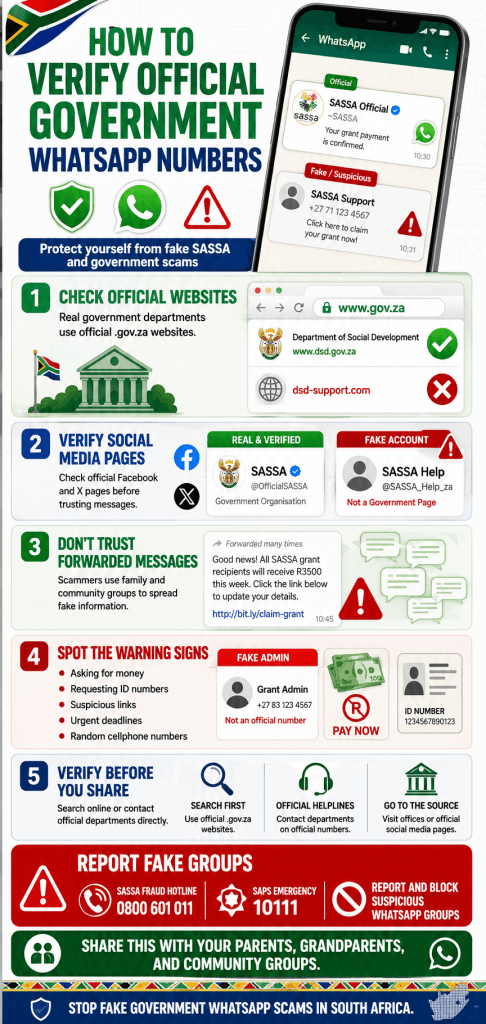
Before trusting any message, verify the information independently.
Check Official Government Websites
Always confirm announcements on official platforms.
Use trusted websites such as:
- SASSA
- Gov.za
- Department of Social Development websites
Avoid relying only on forwarded messages.
Look for Verified Social Media Pages
Official departments usually post announcements on:
- X
- Government websites
Verified pages often have:
- Blue verification badges
- Official contact information
- Consistent branding
Search for Public Statements
If a major grant programme exists, reputable news websites will report on it.
Search online before sharing personal information.
Never Trust WhatsApp Alone
WhatsApp is easy to abuse because messages spread quickly.
Even if:
- Your friend shared it
- A relative forwarded it
- Thousands joined the group
The information may still be fake.
Example Scam Scenario
Thandi joins a WhatsApp group called “SASSA R1400 Registration 2026.”
The group has over 800 members and uses a SASSA logo. Admins claim registrations close that evening.
Soon afterward, an admin asks members to:
- Send ID numbers
- Submit banking details
- Pay R120 for “processing”
Thandi pays the money because she fears missing out.
After payment:
- The admin stops replying
- Messages disappear
- The group becomes locked
- The scammers remove several members
Unfortunately, this pattern is common across many fake government WhatsApp groups.
ALSO READ: Scholar Transport Safety in Johannesburg: Get Free BESAFE Training Today
How to Report Fake WhatsApp Groups
Reporting scammers can help protect others.
Report the Group on WhatsApp
You can report a group directly inside WhatsApp.
Steps:
- Open the group
- Tap the group name
- Scroll down
- Select “Report Group”
- Exit the group afterward
You should also block suspicious admins.
Contact the SASSA Fraud Hotline
If the scam involves grants or SASSA impersonation, contact the SASSA fraud hotline:
- 0800 601 011
Report:
- Fake grant messages
- Fraudulent payment requests
- Scam registration groups
Contact SAPS
You can also report fraud to the South African Police Service.
Emergency number:
- 10111
If money was stolen, gather:
- Screenshots
- Phone numbers
- Payment proof
- Chat history
This information may assist investigations.
How to Protect Yourself and Your Family
Scam prevention starts with awareness.
Follow these safety tips:
- Never pay for government applications
- Do not share OTP codes
- Verify every opportunity independently
- Avoid clicking suspicious links
- Question urgent payment requests
- Warn older family members
Additionally, teach children and grandparents how these scams work.
Many scammers specifically target:
- Elderly pensioners
- Unemployed youth
- Low-income households
Why These Scams Spread So Quickly
Government WhatsApp scams South Africa continue to grow because WhatsApp is widely used.
Forwarded messages often appear trustworthy because they come from:
- Friends
- Family members
- Community groups
- Church groups
However, scammers rely on emotional reactions rather than facts.
People often forward messages without verifying them first.
As a result, fake DSD messages South Africa spread rapidly across communities.
Frequently Asked Questions
Are government WhatsApp groups real?
Some departments use WhatsApp for communication. However, official registrations and applications usually happen through government websites.
Always verify the number independently.
Does SASSA ask for registration fees?
No. SASSA does not charge registration or activation fees for grants.
Can fake WhatsApp groups steal money?
Yes. Some scammers use stolen banking information or trick victims into making payments.
Fake grant application scams continue to affect thousands of South Africans every year.
Scammers use fear, urgency, and false hope to manipulate vulnerable people. Therefore, every message should be verified carefully.
Never trust a WhatsApp group simply because it has:
- Many members
- Government logos
- Confident admins
- Viral forwards
Always confirm information through official government channels first.
Please share this article with everyone in your family — especially parents, grandparents, and anyone who depends on WhatsApp for government information.